Article
10 Most Common E-Shop Mistakes That Cost You Customers (Are You Making Them Too?)
Wondering why your conversions aren't growing? You might be making one of these 10 common e-commerce mistakes that drive customers away. Let's uncover and fix them.
Published on: 12.7.2026 • Written by: Team Launify Reading Time: 15 min
10 Most Common E-Commerce Mistakes That Cost You Customers (Are You Making Them Too?)
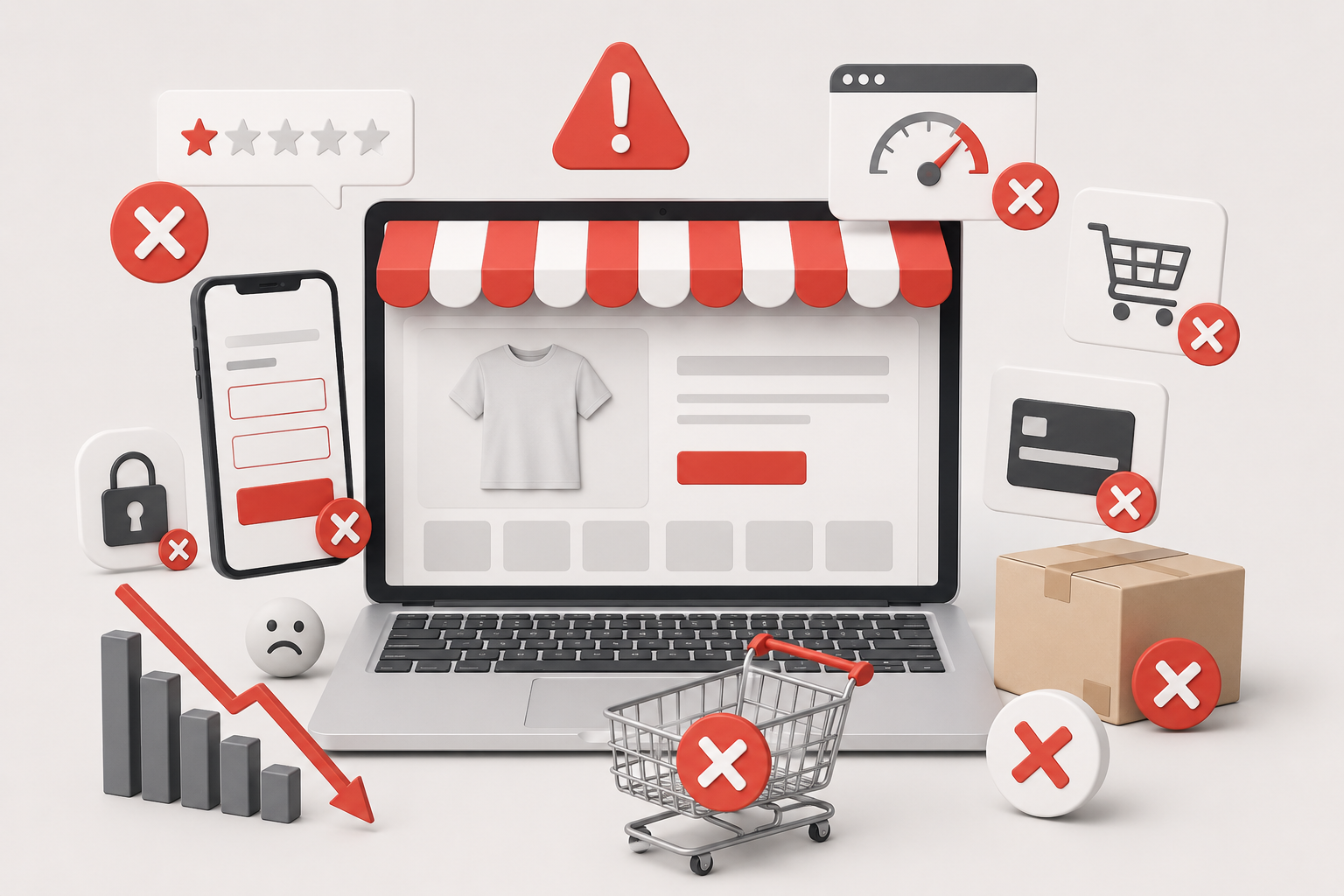
Are you running an e-shop and wondering why customers abandon their carts, don't return, and why conversions aren't growing as you'd like? Often, it's not about high prices or a bad product. The cause might lie in small but critical mistakes that have crept onto your website. Let's take a look at the 10 most common mistakes you might be making without even realizing it.
1. Overly complex and lengthy checkout
Congratulations, you got the customer all the way to the cart! Now, the main goal is not to lose them. Right here, just before the finish line, is where most drop-offs occur. Why? Because of an endless checkout process.
Forced registration, dozens of fields to fill out, unclear steps... All of this is a direct path to an abandoned cart.
Customers want to buy quickly and painlessly. Every extra field is an obstacle. Typos in addresses lead to delivery issues and dissatisfaction on both sides.
Solution: Simplify everything you can. Offer checkout as a guest. And most importantly – automate form filling. Tools like an address autocomplete tool save the customer time, eliminate errors, and make the whole process incredibly smooth. For B2B customers, a company lookup tool by ID/registration number is invaluable, as it automatically fills in all billing details.
2. Ignoring mobile users
Do you know how many people shop on mobile? A lot. And more every day. If your e-shop is not responsive or if its mobile version is slow and confusing, you are missing out on a huge market share. Have you ever tried buying from your own store on a phone? If it's a frustrating experience, you have a problem.
Solution: Your number one priority must be a "mobile-first" approach. The website must be fast, buttons large enough for touch, and the entire process from selection to payment must be seamless on a small screen.
3. Poor quality photos and missing descriptions
In a brick-and-mortar store, a customer can touch, rotate, and try a product. Online, they only have photos and text. Blurry, small, and dark images won't convince anyone. The same goes for a sparse description copied directly from the manufacturer.
Solution: Invest in professional photos from multiple angles. Show the product in context, add a video. Write original, engaging, and persuasive descriptions that answer all potential customer questions. Mention materials, dimensions, usage, and benefits.
4. Confusing navigation and poor search
“If I don't find it within a few seconds, I'm leaving.” This is the motto of today's online shopper. If your website structure is chaotic, categories are poorly named, and the internal search engine returns irrelevant results (or nothing), the customer will quickly give up.
Solution: Create a logical and intuitive menu structure. Use filters and sorting options that make sense. Fine-tune your search to handle typos and offer relevant alternatives.
5. Hidden costs at checkout
Probably the biggest conversion killer. A customer has items worth 1,000 CZK in their cart, happily goes through the checkout, and at the final step, they are hit with 150 CZK shipping and 50 CZK packaging fees. A feeling of betrayal and an immediate exit is a common reaction.
Solution: Be transparent from the very beginning. Inform about shipping prices as early as possible, ideally right on the product page or in the website header. Offer free shipping above a certain threshold – it's a great motivator for higher order values.
6. Forced registration before purchase
We get it, you want to collect data and build a customer database. But forcing someone to create an account, remember another password, and fill in unnecessary details just to make a one-time purchase is wrong. It discourages many people.
Solution: Always offer a guest checkout option. You can offer the option to create an account after they complete the order, explaining that it will make their next purchase easier.
7. Poor customer communication
The customer paid and... silence. No confirmation email, no shipping info, no tracking number. Uncertainty breeds dissatisfaction. Likewise, it's a major issue when you can't reach the customer because they provided the wrong phone number.
Solution: Automate your communication. Send an order confirmation email, followed by a dispatch notification with a tracking number. To prevent issues with contact details, use a phone number validator directly in your forms. This ensures the entered number is in the correct format and actually exists, preventing unnecessary delivery issues.
8. Insufficient shipping and payment information
Customers want to know their options even before adding an item to the cart. Who will deliver their package? When? Can they pay by card, bank transfer, or cash on delivery? If they have to search hard for this information, their trust in your e-shop drops.
Solution: Create a clear "Shipping and Payment" page and link to it from both the footer and the product pages. Consider showing an estimated delivery date directly on the product page.
9. Slow page loading
In the digital world, seconds count. If your website takes longer than 3–4 seconds to load, you are losing a significant portion of potential customers. No one has the time or patience to wait.
Solution: Optimize images (compress them), use caching, choose quality hosting, and minimize unnecessary scripts. You can test your website's speed using free tools like Google PageSpeed Insights.
10. Underestimating the power of reviews and social proof
People trust other people more than advertising. If your e-shop lacks product ratings or reviews from other customers, you appear less trustworthy. The customer won't be sure if the product is high quality or if your shop is reliable.
Solution: Actively collect reviews. Send customers an automated email requesting a review a few days after delivery. Display reviews visibly on product pages. Trust is also built through badges, certifications, or client testimonials.
Conclusion
Perhaps you recognized yourself in some of these points. That's a good thing! The first step to improvement is recognizing the mistake. Go through your e-shop from a customer's perspective and be brutally honest with yourself. Often, even small changes, like simplifying forms with smart autocomplete tools, can have a huge impact on your success rate. Best of luck!