Article
Why some e-shops grow even without a higher advertising budget

Published on: 30.6.2026 • Written by: Team Launify Reading Time: 15 min
Why some e-shops grow even without a higher advertising budget
Many e-shop owners react to a drop in sales or stagnation in growth the same way: by immediately increasing their advertising budget. They invest more money into PPC campaigns, remarketing, and new acquisition channels. In doing so, they often overlook a much more fundamental question:
What if the problem is not a low number of visitors, but how small a percentage of them actually end up making a purchase?
The fastest path to growth does not necessarily have to lead through constantly increasing marketing spend. In many cases, it is enough to make more efficient use of the traffic your e-shop is already generating.
Most e-shops are solving the wrong problem
Imagine a model example of an e-shop that receives 50,000 users per month with an average conversion rate of 2%. This represents approximately 1,000 completed orders. To increase sales, two different scenarios present themselves:
Scenario 1: Increasing the marketing budget
- You increase advertising spend by 20%.
- You acquire 60,000 visitors.
- While maintaining a 2% conversion rate, you reach 1,200 orders.
Scenario 2: Optimizing the existing website
- Traffic remains at the original value of 50,000 users.
- Thanks to website modifications, the conversion rate increases from 2% to 2.4%.
- The result is likewise 1,200 orders.
While in the first case you must permanently pay more to acquire new users, in the second scenario you work much more efficiently with what you already have available. That is precisely why successful e-shops pay increasing attention to conversion rate optimization (CRO) instead of endlessly raising budgets.
Advertising costs are rising in the long term
Competition in the e-commerce sector is significantly higher today than in previous years. Cost per click (CPC) is rising across all major advertising platforms, meaning that acquiring each subsequent customer is becoming increasingly expensive.
Many e-shops thus find themselves in a trap where:
- they spend more and more money on advertising,
- they acquire a comparable number of orders,
- their net margin is gradually thinning.
The most profitable growth therefore often does not come from increasing traffic, but from maximizing the efficiency of the sales process.
Look for friction points in the purchasing process
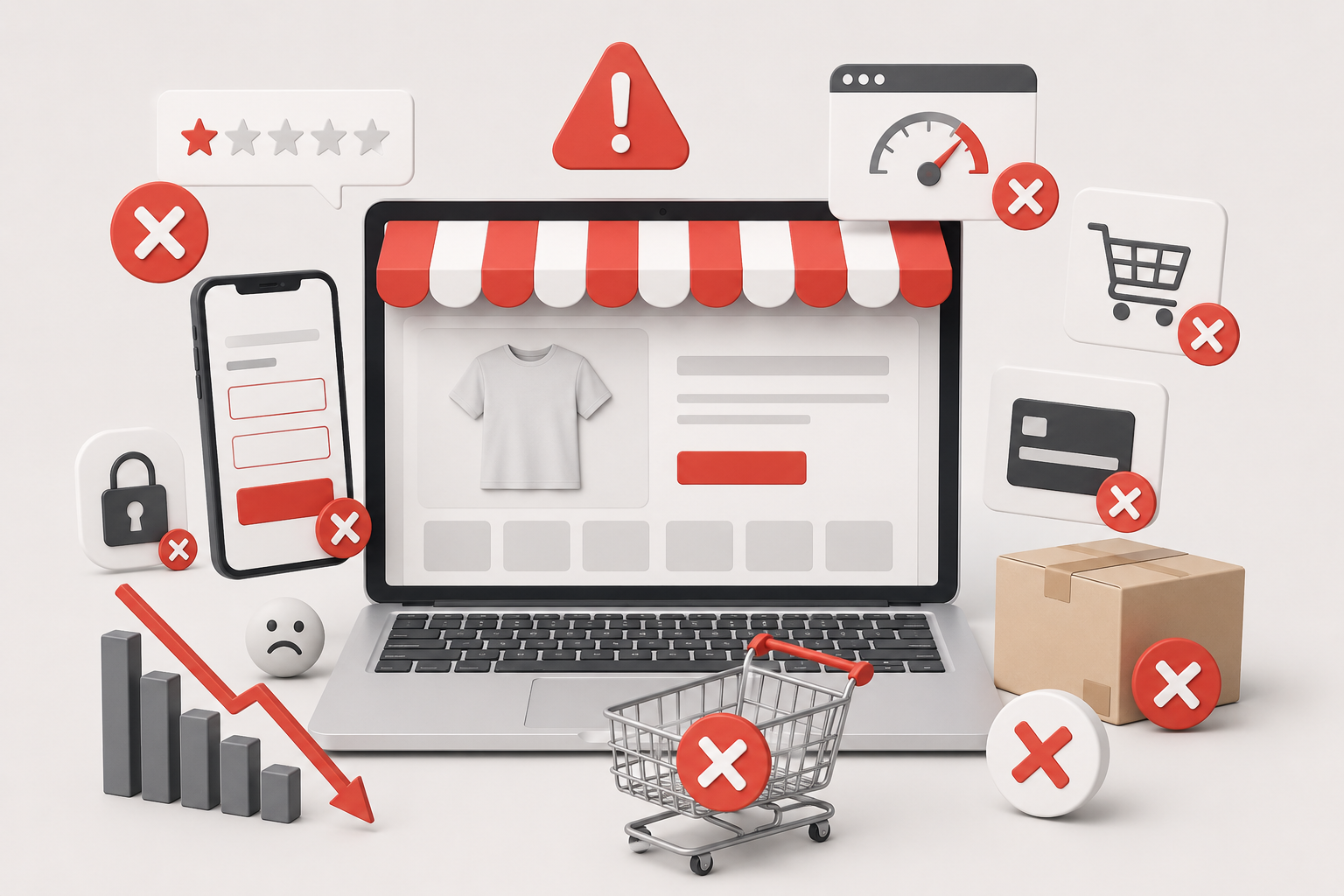
Every step between viewing a product and a completed order represents a potential obstacle for the customer. Users most often abandon their shopping cart for these reasons:
- complicated and confusing checkout,
- slow website loading,
- unexpected or excessively high shipping costs,
- forced registration before purchase,
- excessively long and complex forms,
- untrustworthy-looking website design.
Usually, this is not a single major issue, but dozens of minor obstacles that collectively significantly reduce the overall conversion of the e-shop.
The greatest opportunities hide in the very end of the purchasing journey
E-shop owners often spend dozens of hours optimizing product pages or tweaking SEO. However, the customer's key decision takes place in the final minutes of the buying process. The checkout page is precisely where e-shops lose the largest volume of sales.
Typical flaws in the checkout include:
- unnecessary number of required fields,
- complex and error-prone entry of delivery addresses,
- confusing division of the order into steps,
- missing key information on shipping and payment options,
- poor ergonomics and usability on mobile devices.
Removing these barriers is both technically and financially easier than constantly acquiring thousands of new visitors.
Mobile shopping as the new standard
In most e-commerce segments today, traffic from mobile devices clearly dominates. This fundamentally changes the rules of the game. Elements that work on desktop can be user-unfriendly on a mobile phone.
Mobile customers are highly sensitive to:
- form length and the need to type on a keyboard,
- the number of clicks required to complete an action,
- repeated retyping of details when errors occur,
- complicated search and address entry.
Every unnecessary field in the mobile interface demonstrably increases the risk of cart abandonment.
Automation of small tasks brings big results
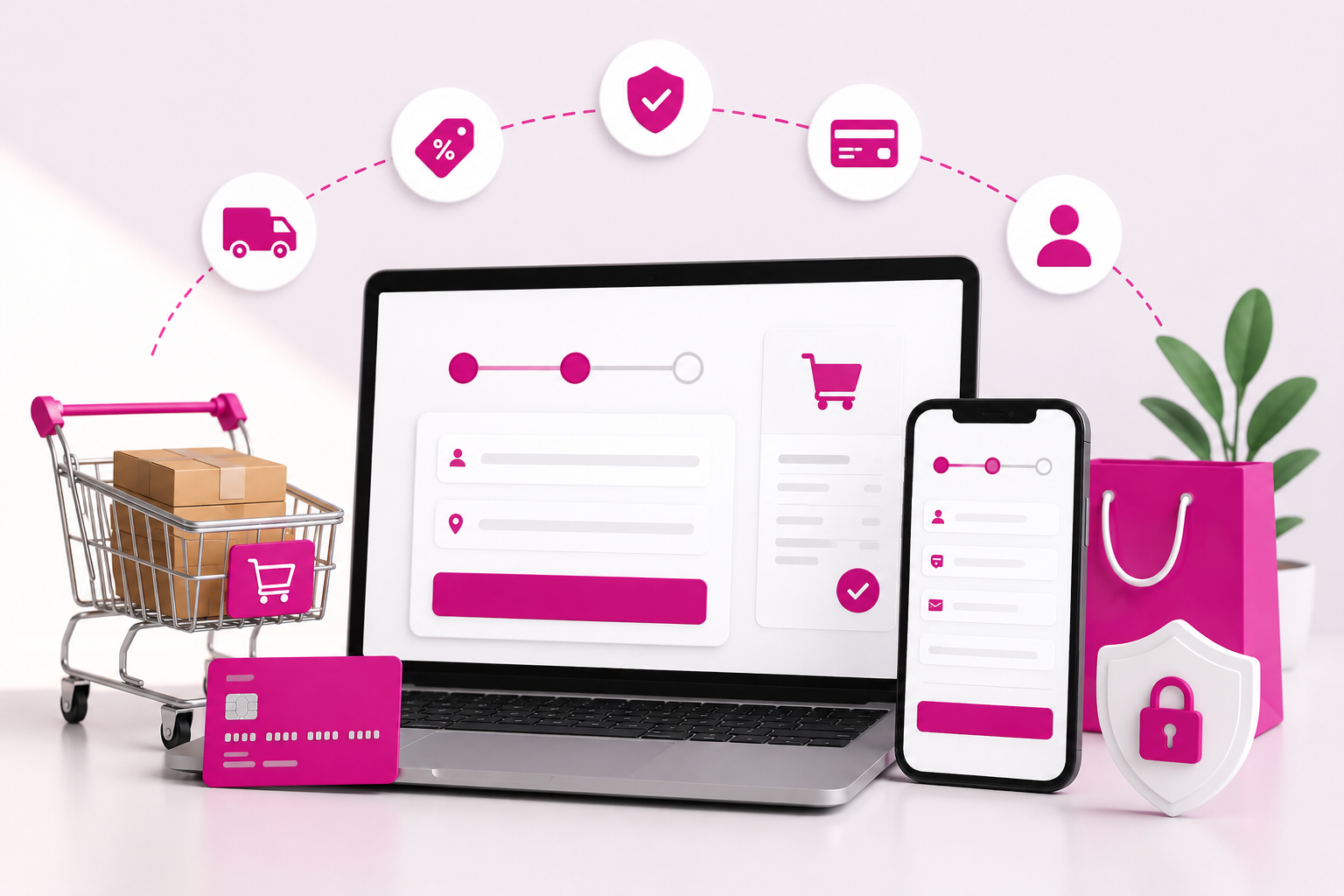
Modern e-commerce focuses on removing any cognitive load from the customer. The goal is to minimize the effort that the user has to exert to make a purchase. Therefore, the following solutions are becoming the standard:
- intelligent autofill and automatic completion of addresses,
- secure storage of payment methods for one-click purchasing,
- personalized product recommendations,
- pre-filling of details for returning customers.
The fewer steps and manual work a customer has to perform, the higher the probability of successful order completion.
Small changes have a cumulative effect
Some e-shop operators reject optimization, arguing that minor adjustments will only bring improvements of tenths of a percent. In the long run, however, these small changes create a huge competitive advantage.
If you systematically:
- speed up the checkout process,
- reduce error rates when filling out forms,
- optimize the mobile version of the website,
- boost the credibility of the entire purchasing process,
the result will be an increase in the conversion rate by full percentage points. With thousands of orders per month, this represents a major boost to net profit.
Growth begins with optimization, not a higher budget
Successful e-shops do not focus only on driving new audiences. Their main priority is maximizing the value of existing traffic. Before you decide to increase marketing budgets, ask yourself a crucial question:
How many orders per day are you losing just because of unnecessary obstacles in the purchasing process?
You will very likely find that the greatest potential for sales growth lies directly in your checkout.
Do you want to simplify the order process?
One of the most common sources of friction is the manual entry of delivery details. Customers often make typos, the filling process delays them, and as a result, they do not complete the order.
The Launify service allows you to implement intelligent address autocomplete into your checkout in just a few minutes. Customers only need to type the first few characters, and the system automatically fills in a complete and valid address.
You will get a faster checkout experience, the elimination of errors in shipping addresses, and a significantly more convenient purchasing process for your customers. More information can be found at launify.com.