Article
AI Revolution for Your E-shop: Build an Army of Employees with OpenClaw
Forget the limits of growth. Introducing OpenClaw – the key to building an autonomous AI army that will turn your e-shop into an unstoppable machine.
Published on: 13.3.2026 • Written by: Team Launify Reading Time: 15 min
AI Revolution for Your E-shop: Build an Army of Employees with OpenClaw
Managing a modern e-shop is an extremely complex operation. It's not enough just to have good products – success requires a constant presence on dozens of channels, immediate reactions to customer queries, precise inventory management, sophisticated marketing campaigns, data analysis, and hundreds of other daily tasks.
The average e-shop owner spends over 60% of their time on operations instead of strategy.
Traditional solutions – hiring more people – are expensive, slow, and scaling has its limits. Outsourcing is better, but you still run into communication barriers, different time zones, and inconsistent quality. What if there was a third way?
OpenClaw is an open-source framework for creating, deploying, and coordinating autonomous AI agents. These agents aren't just chatbots with limited answers – they are full-fledged digital workers with memory, the ability to plan, use tools, and coordinate work among themselves. And crucially: they can create their own subagents for specialized sub-tasks.
Imagine managing a billion-dollar e-shop with just a handful of key human strategists while dozens of AI agents handle daily operations. This isn't a dream; it's your new competitive advantage.
What is OpenClaw?
OpenClaw is an open-source framework that allows you to create, manage, and coordinate autonomous AI agents. Think of it as a building set for your digital workforce. These agents aren't just ordinary chatbots. They are specialized workers who can independently think, plan, use tools (like your e-shop system or CRM), and complete complex tasks.
The framework communicates via standard protocols – agents send structured messages, pass context, and coordinate through a central orchestrator. The entire system runs on your own server (or cloud), so your data never leaves your infrastructure.
🏗️ Key components of OpenClaw
- Orchestrator – the central brain that receives commands from the user and delegates them to the right agents
- First-level agents – main managers responsible for entire areas (marketing, logistics, customer support...)
- Subagents – specialized workers launched by a higher-level agent for specific sub-tasks
- Tools – API connectors, database access, scripts, webhooks
- Memory – vector database for long-term memory + context window for short-term
- Event bus – a system for asynchronous communication and task handovers between agents
How an agent thinks and acts? The ReAct loop
Every agent in OpenClaw operates on the principle of the so-called ReAct loop (Reason + Act). This loop repeats until the agent achieves its goal or encounters a problem requiring human intervention:
- THINK – The agent analyzes the assignment, breaks it down into sub-steps, and considers what tools or subagents it needs.
- PLAN – It creates a concrete action plan with priorities and dependencies.
- ACT – It performs the first action (calls an API, launches a subagent, processes data).
- OBSERVE – It evaluates the result of the action. Was it successful? Does the plan need adjustment?
- REFLECT – It updates its working memory and decides on the next step.
- REPORT – After completion, it reports results to the superior agent or user.
The key difference from simple chatbots: the agent doesn't need your instructions for every step. It gets a goal and finds the path itself.
Agent Hierarchy and Subagents – The Heart of the System
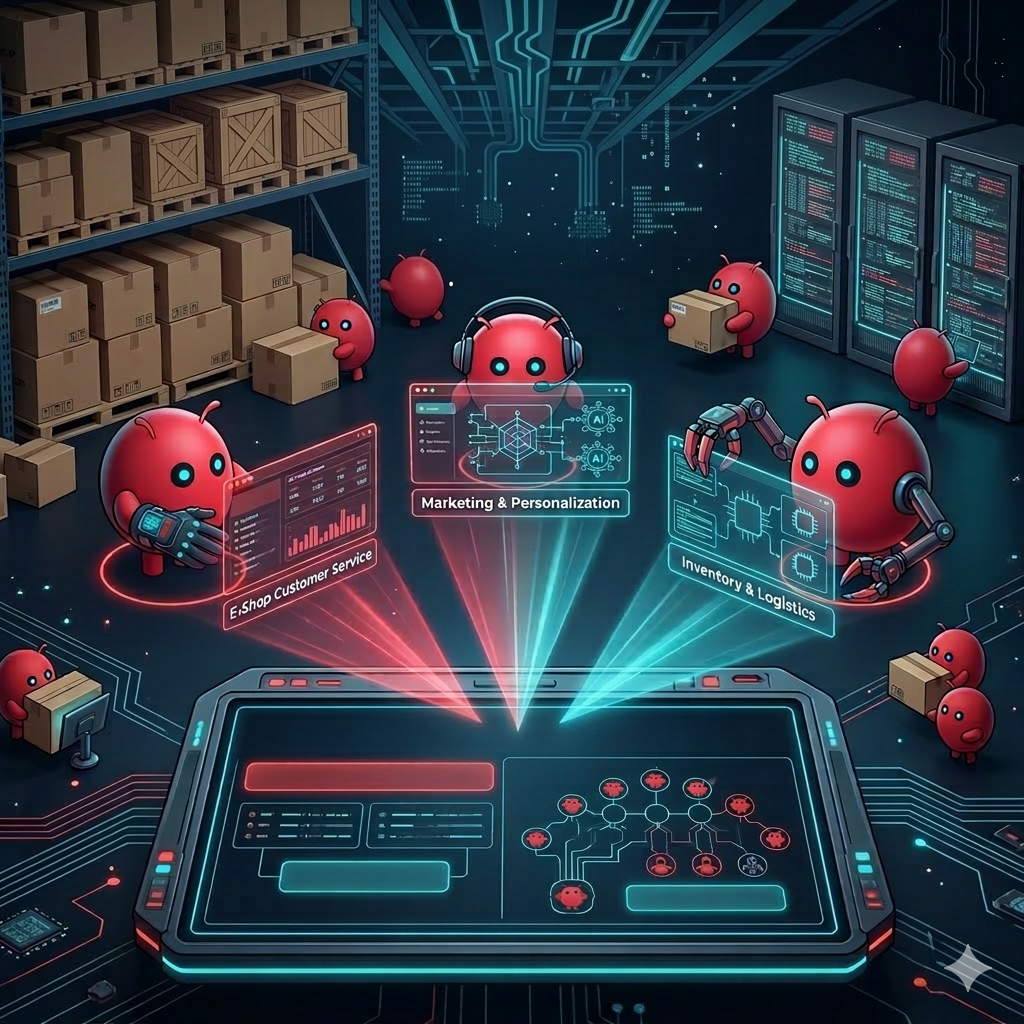
The most powerful feature of OpenClaw is the ability of agents to dynamically launch their own subagents. It works like in a real company: a manager receives a project, builds a team of specialists, coordinates their work, and returns the result.
| Level 0 – User | You. You assign main goals via WhatsApp, Slack, web interface, or email. |
| Level 1 – Orchestrator (Eva) | Main AI Manager. Receives your commands, decomposes tasks, delegates to Level 2 agents, monitors progress, and reports. |
| Level 2 – Domain Agents | Specialists in entire areas: Marketing (Martin), Logistics (David), Support (Klára), Programmer (Alex). Each manages their domain and has their own team of subagents. |
| Level 3 – Subagents | Dynamically launched by Level 2 agents. Martin launches a "Copywriter subagent" and a "Data Analyst subagent". David launches "Inventory Checker" and "Supplier Communicator". |
| Level 4 – Micro-task Agents | Ultra-specialized agents for specific atomic tasks: translate text, validate data, generate an image, send an email. |
Why is this hierarchy so powerful? Because every agent works in parallel. While Martin analyzes data, David checks warehouses, and Klára answers customers – all at the same moment, 24 hours a day, 7 days a week.
Meet Your New Team
Let's imagine what your new company structure could look like. You manage everything from a single application, for example, WhatsApp, where you assign tasks to your main AI manager. Let's say her name is Eva. Eva manages other AI agents under her; let's imagine them as Klára, Martin, David, and Alex.
Klára, Your Customer Support Star
Klára is always online. With endless patience, she resolves customer queries. Where is my order? What are the return conditions? Can you recommend a product? Klára connects to your system, finds the answer immediately, and professionally communicates everything necessary. More complex cases requiring human intervention are automatically forwarded with a complete summary to your human colleague.
Klára doesn't manage everything alone – she has her own team of subagents:
| 💬 LiveChat-K | Real-time chat on the web: queries, product recommendations, order tracking |
| 📧 EmailSupport-K | Processing incoming emails with categorization and prioritization |
| ⭐ ReviewManager-K | Monitoring reviews on Heureka, Zboží.cz, Google; responding to reviews |
| 👑 VIPCare-K | Proactive care for customers with turnover over 5,000 CZK: birthday offers, preview of new collections |
| 📞 EscalationAgent-K | Identification of complex cases requiring human intervention + preparation of summary for a colleague |
| 🎁 LoyaltyAgent-K | Loyalty program management, point allocation, benefit management |
Martin, the Marketing Mage
Martin never sleeps and constantly analyzes data. His task is to maximize your revenue. He can segment customers based on purchasing behavior, automatically create personalized email campaigns, write ad copy for Facebook, or suggest A/B tests for your product pages. An assignment like "Create an abandoned cart campaign for customers who viewed shoes" means a few seconds of work for him.
Martin's subagent team:
| 📊 DataAnalyst-M | Analysis of Google Analytics, Ads data, A/B test results, correlation of campaigns with sales |
| ✍️ Copywriter-M | Writing emails, ad copy, product descriptions, blog posts in Czech and Slovak |
| 🎯 SegmentBuilder-M | Customer segmentation based on RFM model, purchasing behavior, preferences |
| 📧 EmailOrchestrator-M | Planning and sending email sequences via Mailchimp/Klaviyo/Ecomail/Smartemailing API |
| 🔍 SEOAgent-M | Position monitoring, competitor analysis, optimization suggestions, link building opportunities |
| 📱 SocialMedia-M | Managing posts on Instagram and Facebook, responding to comments |
| 💰 PaidAds-M | Optimization of Google Ads and Meta campaigns, bidding strategy, negative keywords |
David, Logistics Coordinator
David has your warehouse inventory and logistics under control. He monitors sales and, based on predictive models, alerts you when a popular t-shirt size is running low. He can automatically create a purchase order with the supplier, track shipments, and inform customers about their delivery status. Problems in the supply chain? David identifies them before you even notice.
Example of David's automatic action – without any human intervention:
08:14– InventoryMonitor-D detects: Nike Running Socks L, M – 3 packs remaining (safety stock = 15)
08:15– DemandForecaster-D calculates: stock will run out in 4 days
08:16– PurchaseOrder-D prepares order: 50 packs L + 60 packs M from supplier Sport Import s.r.o.
08:17– SupplierComm-D sends email to supplier with the order
08:18– David reports to Eva: “Automatically ordered 110 packs of Nike socks, awaiting supplier confirmation”
Human intervention: 0 minutes.
David's subagent team:
| 📦 InventoryMonitor-D | Real-time monitoring of warehouse status, alerting when dropping below safety stock |
| 🔮 DemandForecaster-D | Demand prediction based on historical data, seasonality, and trends |
| 📋 PurchaseOrder-D | Automatic creation of orders with suppliers according to rules and predictions |
| 🚚 ShipmentTracker-D | Tracking shipments from suppliers and to customers, proactive communication |
| 🤝 SupplierComm-D | Email communication with suppliers: requests, claims, price negotiations |
| 📉 DeadStock-D | Identification of slow-moving goods and suggestions for clearance actions for Martin |
| 🔄 ReturnProcessor-D | Processing of returns, warehouse updates, communication with the customer |
Alex, Your Personal AI Programmer
This is a real revolution. Alex is an AI agent who can program. Need to quickly create a script for data export? Want to connect two systems via API but don't have time to wait for a developer? Alex can handle it. You give him tasks in natural language, and he generates, tests, and deploys code. He fixes bugs, optimizes databases, and builds new microservices. Yes, you read that correctly.
| 🐞 BugHunter-A | Monitoring error logs, automatic error diagnosis, and implementation of fixes |
| 🔗 APIIntegrator-A | Implementation of new API integrations according to specifications from Eva or other agents |
| 📊 DataPipeline-A | Creating ETL scripts for moving and transforming data between systems |
| 🔐 SecurityScanner-A | Regular security scans, monitoring of attack attempts, alerting |
| ⚡ PerformanceOpt-A | Analysis of slow queries, database optimization, cache strategies |
| 🤖 AutomationBuilder-A | Creating new automation scripts based on requirements from other agents |
Integrations That Change the Game
The power of these AI employees lies in their ability to connect to tools you already use. This allows them to realistically influence your business operations.
- Pipedrive / HubSpot: Martin can automatically create new leads, update the status of business cases, and record communication with customers.
- Airtable / Google Sheets: David can manage spreadsheets with warehouse stock, orders with suppliers, or track key metrics in real-time.
- ClickUp / Trello: Eva can create and assign tasks for human team members, track their progress, and ensure nothing gets lost.
- Google Analytics, Google Search Console, Google Tag Manager, Google Ads: Martin can optimize your campaigns relative to current data thanks to access to GA, GTM, etc. – he never sleeps, takes no vacations, and just keeps working.
- Shoptet / Shopify, Heureka / Zboží.cz: Reading orders, updating statuses, managing products and prices, monitoring feeds, tracking competitor prices, editing templates, or translating products.
- Zásilkovna / PPL / GLS: Tracking shipments, automatic customer notification, handling delivery claims.
Deployment Economics:
- One-time implementation costs. (ranging from thousands to tens of thousands)
- Monthly operating costs: 12,000 – 80,000 CZK (server + AI models via OpenRouter) depending on the size of the AI team
- Equivalent human team: 4–6 employees = 180,000 – 280,000 CZK/month
- Return on investment: typically 2–4 months
Technical Infrastructure: How to do it?
Hosting on Hetzner: For maximum control, security, and scalability, we recommend deploying OpenClaw on your own server. Hetzner offers a great price-performance ratio for robust cloud servers; alternatively, you can run OpenClaw on a MacMini directly in the office or at home.
Access to models via OpenRouter: So you don't have to deal with dozens of different APIs for individual language models (like GPT-4, Claude 3, Llama 3), you'll use OpenRouter. This acts as a gateway that provides access to the best models on the market through one API and allows you to cleverly optimize costs according to task complexity.
Phase 1 – Pilot Deployment (1–4 weeks)
Start with one agent. Best candidate: customer support (Klára).
- Integration with e-shop system (reading orders)
- Connection to email and live chat
- Training on your products and FAQ
- Setting up escalation rules for the human team
- Monitoring and fine-tuning for 2 weeks
In phase one, arm yourself with a lot of patience and time; it's necessary to teach AI agents access credentials and tokens. All this with the help of you and your time, as you fly from interface to interface setting up API keys.
Phase 2 – Team Expansion (5–12 weeks)
After a successful pilot, add a marketing agent (Martin) and deploy the Orchestrator (Eva).
- Deployment of Martin with email marketing subagents
- Connection with Google Analytics and Ads
- Implementation of Eva as a coordinator
- Setting up daily/weekly reporting routines
Phase 3 – Full AI Team (13–24 weeks)
Deployment of remaining agents (David, Alex, Petra) and their subagents.
- David + supply chain integration
- Alex + dev pipeline (security gateway, sandbox)
- Petra + financial reporting integration
- Full launch of WhatsApp/Slack interface for the owner
The Future is Here (and it's Autonomous)
The ability to quickly and efficiently scale operations separates successful e-shops from those that perish. With an army of AI employees built on OpenClaw, you can compete even with the largest players without having to hire dozens of people. You can focus on vision and strategy while your digital team handles the execution.
The future of successful e-commerce isn't in who has the most people – but in who most intelligently combines human judgment with AI capabilities. People handle vision, relationships, and strategic decisions. AI agents handle operations, data analysis, and continuous monitoring.
SportX with an AI team based on OpenClaw doesn't need 20 employees to function as a company with a turnover of 100 million. It only needs 5 key people and an army of digital specialists who never sleep.
This technology is not science fiction – it's available today, deployable within weeks, and its economics speak clearly. The question is not whether to invest in AI agents. The question is whether to do it before your competition.
Don't know where to start? Feel free to write to us!
Interested in the idea of your own AI army, but don't know where to start with technical implementation? We understand. That's why, if you're interested, we can agree on a turnkey integration directly for you.