Article
Czech House Numbers Explained: Why Customers Get Them Wrong and How Your Checkout Form Can Prevent It
A Czech building can have two house numbers, and customers often enter only one. Here is what each number means, the most common mistakes and how to set up your form, with ready-made messages.
Published on: 17.11.2026 • Written by: Team Launify Reading Time: 5 min
Czech House Numbers Explained: Why Customers Get Them Wrong and How Your Checkout Form Can Prevent It
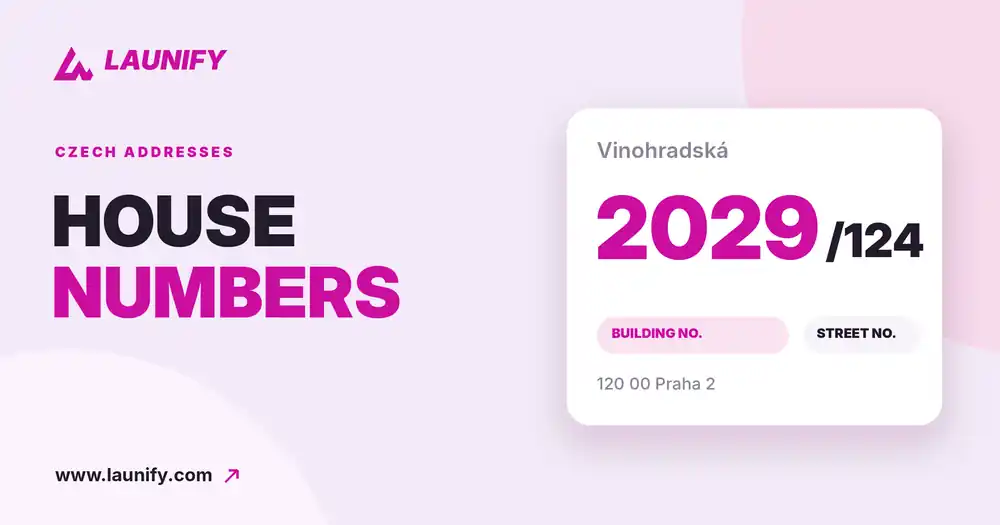
An apartment building in Prague's Vinohrady district has two plates on its wall: a red one with 2029 and a blue one with 124. A customer types “Vinohradská 2029” into your checkout, because that's the number on her rental contract. The courier walks down the street following the blue numbers, never finds 2029, and the parcel goes back to the depot. You pay for shipping twice. (Illustrative example.)
If you ship to Czechia, this matters to you. A Czech address can carry two house numbers, plus a third type used for holiday cottages. Customers get confused because authorities, contracts and map apps all show the numbers differently. Here is what each number means, the mistakes you'll see most often in orders, and how to set up your form to catch them.
Your form shouldn't test customers on address law. It should let them type the address the way they know it, then turn it into something the courier understands.
Three numbers, three meanings
Building numbering is set out in the Czech Act on Municipalities and explained in detail in guidance from the Czech Ministry of the Interior:
- Číslo popisné (č. p.) – the building's registry number, unique within a part of the municipality. It identifies the building but says nothing about where it stands on the street.
- Číslo orientační (č. o.) – the street number. Optional, only assigned in named streets, and it can include a lowercase letter, e.g. “14a”.
- Číslo evidenční (č. ev.) – used mainly for holiday cottages and temporary buildings. It is a separate series, so the same village can have both č. p. 5 and č. ev. 5.
How a Czech address is written
The format is set by the decree for the RÚIAN address register, published by ČÚZK. Four cases every form should handle:
- Street with both numbers: “Studentská 1903/14a, 160 00 Praha 6” – registry number first, street number after the slash.
- Village without streets: “Dolní Adršpach 13”.
- Cottage number: “Koliště č. ev. 1” – the “č. ev.” prefix is always required.
- No street and no village part: “č. p. 111, 503 33 Praskačka”.
The five mistakes you'll see most often
1. Only one number
The customer types just “2029” or just “124”. In a city, the street number is more useful to the courier; the registry number helps avoid mix-ups. Both together is safest.
2. Second number in a “Flat” field
Forms built for Poland or the UK often have an apartment field. Czech customers put “124” there, creating an address that doesn't exist in the carrier's system.
3. Reversed order
“14a/1903” instead of “1903/14a”. If the carrier splits the numbers at the slash, the parcel heads for a different building.
4. Cottage without “č. ev.”
“Koliště 1” points to the building with registry number 1, not the cottage with č. ev. 1.
5. Village name in the street field
If the street is mandatory, customers from villages without streets type the village name there. Automated address checks then flag it as a non-existent street.
How to set up your form for Czech addresses
- One text field for the house number, not two. Most customers don't know which number is which.
- Hint next to the field (in Czech): “Např. 1903/14a. Pokud má dům dvě čísla, napište obě.” (“E.g. 1903/14a. If the building has two numbers, enter both.”)
- Allow digits, letters, slash, space and dot. Never use
type="number". - Normalise input: turn “1903 / 14 A” into “1903/14a”.
- Make the street optional; house number and town are required.
- Hide or relabel the flat field for Czech addresses so it isn't mistaken for the second house number.
Even more reliable is not making customers type the numbers at all. RÚIAN data is freely available, according to BusinessInfo.cz, and every address has a unique address-point code. Address autocomplete built on this data – several services offer it, Launify among them – shows the full address with both numbers and the postcode as soon as the customer types the street and either number.
Ready-to-use messages (Czech, with English meaning)
- “Doplňte prosím číslo domu. Pokud má dům dvě čísla (např. 1903/14a), napište obě.” – Please add the house number; if there are two, enter both.
- “Obec nemá ulice? V pořádku, stačí číslo domu.” – No streets in your village? That's fine, the house number is enough.
- “Jde o chatu? Napište před číslo ‚č. ev.‘.” – Is it a cottage? Put “č. ev.” before the number.
- Confirmation email: “Doručíme na adresu: Vinohradská 2029/124, 130 00 Praha 3. Pokud něco nesedí, odpovězte nám a opravíme to před odesláním.” – We'll deliver to…; reply if anything is wrong and we'll fix it before dispatch.
What to do right now
- Try entering “1903/14a”, “Dolní Adršpach 13” with no street, and “č. ev. 12” in your Czech checkout. Does everything go through?
- Merge any two house-number fields into one text field with a hint.
- Make the street optional and the house number required.
- Add normalisation for spaces, capitals and slashes.
- Review last quarter's returned Czech parcels: how many had only one house number?
If you'd like Czech addresses with both house numbers to fill in automatically, take a look at launify.com.