Article
Address Formats in Czechia, Slovakia, Poland and Hungary: What to Watch for in Your Checkout Form
A five-digit postcode rule fails in Hungary, and a Polish parcel without a flat number comes back. Here are the address differences across four countries and validation rules ready for your developer.
Published on: 12.11.2026 • Written by: Team Launify Reading Time: 6 min
Address Formats in Czechia, Slovakia, Poland and Hungary: What to Watch for in Your Checkout Form
On day one of your new Hungarian store, an email arrives: “I can't finish my order, it keeps showing an error at irányítószám.” Your form was copied from the Czech version and expects a five-digit postcode – but Hungarian postcodes have four. A week later the first parcel comes back from Poland: the customer lives in an apartment block and only typed “12” as the house number, because there was nowhere to enter the flat number.
Czechia, Slovakia, Poland and Hungary are neighbours, but their addresses each work a little differently. The order of the lines, the postcode format, house numbering and even what is mandatory all vary. Here is an overview of the differences your form has to handle, plus concrete validation rules you can hand to your developer.
A form built for one country doesn't break straight away in another. It fails quietly – with a wrong address you only discover when the parcel comes back.
The overview on one screen
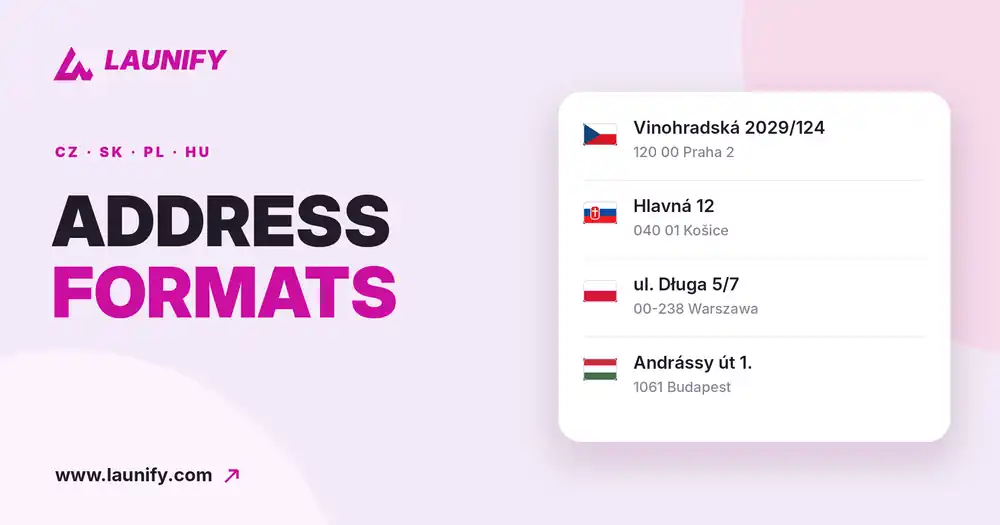
- Czechia: 5-digit postcode, written “160 00”. House numbers are often two numbers with a slash, e.g. “Studentská 1903/14a”.
- Slovakia: 5-digit postcode, “811 01”. Same slash notation, e.g. “Dolná 55/50”. Some addresses have no street at all.
- Poland: 5-digit postcode with a hyphen, “00-590”. Building and flat as “12/34” or “12 m. 34”.
- Hungary: 4-digit postcode, “1052”. The street type (utca, út, tér) is part of the address, often with floor and door too.
Czechia: two house numbers and a slash
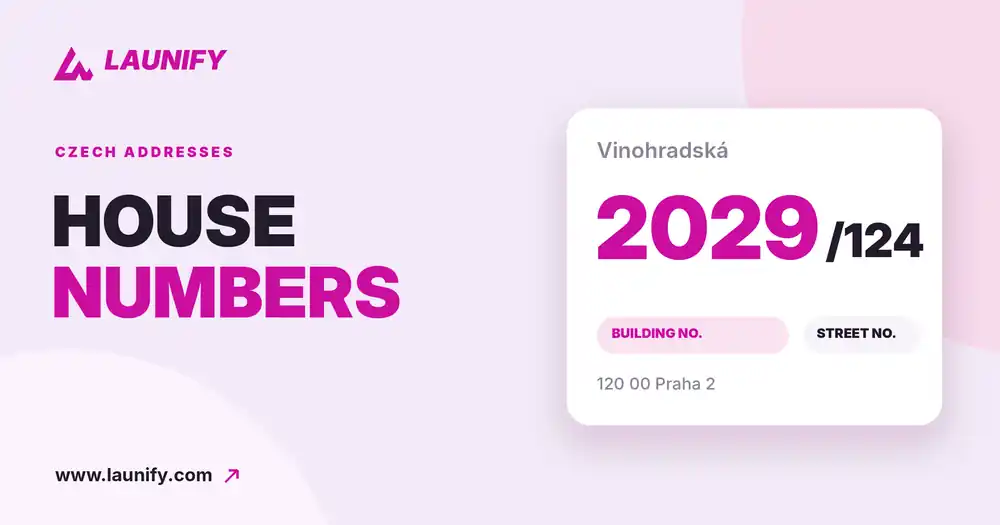
Czech addresses follow the decree for the national address register (RÚIAN). According to ČÚZK, you write the street, the building's registry number (číslo popisné), a slash and the street number (číslo orientační), for example “Studentská 1903/14a, Dejvice, 160 00 Praha 6”.
- The house number is text, not a number. It must accept a slash and a letter. A field with
type="number"will reject it. - Addresses without a street are normal in small villages: just the village part and a number, e.g. “Dolní Adršpach 13”. A mandatory “Street” field blocks these customers.
- Holiday cottages have a separate number series written with “č. ev.”, e.g. “Koliště č. ev. 1”.
Slovakia: same postcode format, gaps in street data
The postcode format matches Czechia (5 digits, “040 01 Košice”). The difference is data quality: in June 2026 Slovenská pošta warned that many municipalities are missing street names or street numbers in the address register, so addresses exist only as a building number, such as “Námestovo 765”.
- Don't make the street field mandatory.
- If the street is empty, house number and town are required.
- Use Slovak labels: “Ulica a číslo”, “PSČ”, “Obec”.
Poland: a hyphen in the postcode and the flat number
Poczta Polska defines the postcode as five digits in the format XX-XXX, written to the left of the town name.
ul. Kwiatowa 12/34
30-001 Kraków
(example: building 12, flat 34)
- The flat number is essential. In large blocks a courier can't deliver without it. Add a visible, optional “Nr lokalu” (flat number) field.
- The slash means something different than in Czechia. In Poland “12/34” is usually building 12, flat 34. Don't let the two get mixed up when exporting to carrier systems.
- Accept the postcode with or without the hyphen and add it automatically.
- Villages without streets: village name plus house number, e.g. “Nowa Wieś 15”.
- Don't ask for the voivodeship. It isn't part of a Polish postal address.
Hungary: four digits, street type and floor
Hungarian postcodes have four digits. In Budapest they start with 1, and the second and third digits give the district: “1052” is District V. The addressing rules of Magyar Posta add a few details most forms ignore:
- The street type is part of the address: utca, út, körút, tér. “Váci utca” and “Váci út” are two different streets in Budapest.
- Only some abbreviations are allowed: “utca” → “u.”, “körút” → “krt.”, but “út” and “tér” are never shortened.
- Floor and door in apartment buildings, e.g. “Váci utca 47. 3. em. 12. ajtó”.
- Accents are required. Magyar Posta lists addresses without accents as a reason mail may fail machine sorting, so never strip diacritics.
- Surname comes first: “Kovács Anna”.
Validation rules to hand to your developer
Apply the rules after stripping spaces and hyphens, then display and store the value in the country's format.
- CZ and SK: exactly 5 digits, display as “XXX XX”. First digit 1–7 for CZ; 8, 9 or 0 for SK.
- PL: exactly 5 digits, display as “XX-XXX”.
- HU: exactly 4 digits, first digit 1–9.
- House number: text up to 20 characters; allow digits, letters, slash, hyphen and dot.
- Phone: country code by country (+420, +421, +48, +36); mobile numbers have 9 digits after the code in all four. For Hungary, also accept the domestic “06 30 …” and convert it to “+36 30 …”.
Format checks won't tell you whether an address exists, though. “1052” passes validation even if the customer lives at “1025”. That's where address autocomplete backed by each country's data helps: the customer picks the address from a list and the postcode, town and street type are filled in correctly. Several services offer this, Launify among them; what matters is that it covers every country you ship to.
Summary: checklist for a four-country checkout
- The customer picks the country first; labels, field order and validation follow from it.
- Postcode: 5 digits for CZ, SK and PL, 4 digits for HU; the form adds spaces and hyphens.
- House number is a text field that accepts a slash and a letter.
- Street is optional; house number and town are not.
- PL and HU show a field for flat, floor and door.
- Diacritics are never stripped.
- Phone numbers are stored with the international code.
- You have placed one test order per country to a real address, including a flat in a block and a village without streets.
If you'd like your form to suggest and check addresses in these countries automatically, take a look at launify.com.